Showing posts with label Royal Palace. Show all posts

Saturday, June 1, 2013

Inside the Royal Palace


You may wonder what it is like inside the Cambodian Royal Palace. Of course, the Palace is home to the Royal Family but it is not just only home, there are also guest rooms, restaurants, religious temples and offices. For the purpose of this page, we will show you only important buildings that are frequently visited by and open to tourists.

The original buildings within the palace complex were built by luxury woods. This is a picture of the Throne of Hall taken in 1826 before the French colony. Nowadays, wooden buildings are replaced by concret structures with pure Cambodian architectural designs. 


This is the concret Throne of Hall that you will see when you enter the palace complex. The building faces the east so it is best for photograph in the mornings. The Throne of Hall is home to golden statutes of the Cambodian former kings, the golden throne and the crown. All the decoration inside this building is made mostly from gold as you will see in the next picture.


The Throne of Hall is used for coronation, diplomatic, official meetings and religious purposes. It is probably the most luxurious building within the palace complex. The picture here features the meeting between His Majesty and the UN Secretary General Ban Ki Moon. 
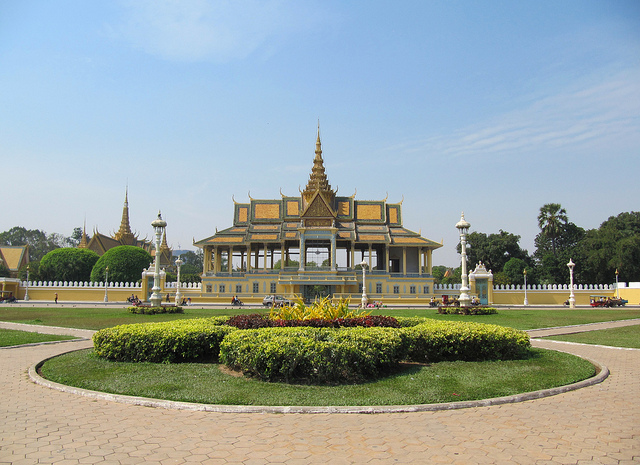

The Moonlight Pavilion - This is the building that is on the complex gate so it is visible as you walk or drive along the complex. The building serves as a venue for the Royal Dancers, for the king to address the crowds and to hold state and Royal banquets. 


The Napoleon Pavilion - It's the only western-style building within the palace complex. It was constructed entirely of iron for the Empress Eugenie of France, wife of Napoleon III in 1869 for the use in the inauguration of the Suez Canal. Then in 1876, the building was shipped to the palace complex as a gift. Now it is used to store royal memorabilia and photographs.


The Silver Pagoda - a buddhist temple used for religious purposes. Many major buddhist ceremonies are held here and it is the second most luxurious building within the palace complex. It is called Silver Pagoda because the floor was made of 5,329 silver tiles, each weighted 1.125kg. It is also a place for cultural and religious treasures that houses more than 1,650 precious objects. The most two precious Buddha statues are the Emerald Buddha made of emerald or baccarat crystal and the Buddha Maitreya made of 90kg of gold and encrusted with 2,086 diamonds plus a 25-caret diamond in the crown and a 20-caret diamond in the chess. 


There are many Stupas around the Silver Pagoda. Stupas are used to store ashes of the former kings and royal families who passed away. There are different styles of Stupas but the one in the picture is the most common.


Finally, the Royal Palace at sunset is beautiful. You can have a walk outside the palace complex and have all amazing views surrounding.


If you have a chance to visit Phnom Penh, the Royal Palace is the first place you should be heading to. You should seek information in advance about the ticket and the schedule because the Palace is open at certain time while some days it is closed. Phnom Penh Day hopes you enjoy visiting this page. 


Tuesday, May 7, 2013

7 places you must visit


Welcome to Phnom Penh!

Phnom Penh is not big but if you don't know where to visit, you may not truely know about this than 5-century-year-old city. It's an old city but unfortunately most of the construction began in the 20th century, so you will not see many old buildings. 

So what makes Phnom Penh so special? We recommend you 7 places to visit

The video below highlights most visited places in the city and the life of local people. 


1. Wat Phnom - the Birth of Phnom Penh

Statute of Daun Penh

Wat Phnom is a man-made hill built in 1373 and served for buddhism. It is the tallest religious building in the city. It's the place that gave birth to the Capital City of Cambodia, Phnom Penh. It is believed that a lady of village called Daun Penh found accidentally four bronze statutes of buddha in a tree floating along the Tonle Sap river, a few kilometers from the hill. She then called for all the villagers to construct a hill and a temple to house the four statutes for serving religious purposes. The name of "Phnom Penh" is followed after the name of the lady "Penh".

Wat Phnom was reconstructed again in 1926 with some new designs and buildings. You can find many paintings and sculptures telling stories of the Buddha and Ramayana, a very famous tale in Cambodia. Wat Phnom is also a park for local people for relaxing and is used for major celebrations such as counting down and dancing during the new year.


2. The Independence Monument


Beautiful, Unique and Meaningful. Built in 1958 by a famous Cambodian architect, Vann Molyvann, the independence monument represents the end of the 90-year colony of the France over Cambodia. Each year on November 9, Cambodia celebrates the independence day at this monument. A ceremonial flame is lit by the King or his representative on the interior pedestal with a praise from monks.


Don't forget to count the statute of snakes on the monument roof. Believe me or not, there are 90 snakes in total representing 90 years under the French colony. Some say there are 100, so let's see which is correct :)


3. The Royal Palace


A combination of Hindu and Buddhism with designs back to the 12th century. It's probably 30 minutes on foot from the independent monument. Residence to the Royal family, the complex also serves religious purposes. The construction began in the 1860s.


There are many temples within the complex serving different purposes in the Royal Palace. Probably the most famous temple is Silver Pagoda that is used to serve buddhist ceremonies and the floor is made solely from silver. Another temple that caught my attention is a European-style establishment that was shipped from Egypt to Cambodia as a gift from the French Napoleon. In addition, in each temple, there are sculptures, statutes, paintings and other fine arts, some of them are made from gold, silver, gems with Cambodian greatest designs.


Remember to dress appropriately or you will not be allowed to enter the complex. Do not wear flip flops, shorts, short skirts or anything that reveals a lot of body parts.


4. Central Market


Central Market from above 
Approximately 30 minutes walk from the Royal Palace, the Central Market is the first colonial style concrete market built in 1937. It opens from 7am and 5pm and it is a must-visit place for tourists, especially those who like shopping local products. The market sells everything from food, daily utilities to clothes and souvenirs. It's the oldest market in the city that remains until today. The Central Market is known as "Phsar Thmey" in Cambodian.


5. Russian Market


Russian Market or Toul Tompoung Market is another famous market for tourists, around 25 minutes on Tuk-Tuk or Motor-Taxi. It offers a variety of local-made souvenirs such as silk clothes, scarves, handicrafts, sculptures, paintings, silver and gold jewels etc. The price is very reasonable. Just get a big baggage and do your shopping.